
Compare Hardin Property Values
Hardin County property values wear several faces. A single parcel can carry an assessment, a fair-cash estimate, recorded consideration, and separate land or improvement figures. Each number comes from a different record and date. Compare like with like before deciding anything is wrong.
| Value | What It Is | Where |
|---|---|---|
| Assessed value | Tax administration value | Hardin PVA |
| Fair cash value | Estimated fair voluntary sale value | PVA context |
| Sale consideration | Transfer figure under deed rules | Recorded deed |
| Land and improvements | Components of a parcel total | PVA property data |
Kentucky now assesses at 100 percent of fair cash value. Even so, a Hardin County assessment need not equal one sale price. Timing, agricultural treatment, improvements, partial interests, family transfers, and gift rules can all pull the figures apart.
Kentucky's Hardin Value Standard
The state Department of Revenue sets the calendar. Real property is revalued every year. Physical inspections happen at least once every four years, and new construction is added annually. Appraisers may rely on sales comparison, cost, or income approaches. Farmland can receive agricultural-value treatment under the applicable rules. Before comparing two Hardin property values, read the land use, valuation year, and parcel facts, because a current assessment is a mass-appraisal result rather than a custom opinion for a sale.
Hardin's Historical Thirty Percent
Hardin's assessment level has not always been 100 percent. A Hardin County Public Library source notes that before 1965, Hardin and much of Kentucky assessed property at 30 percent of fair cash value. Treat that as history, not today's rule. An old tax-book figure only compares with current PVA values once the assessment year and the then-current ratio are known.
Recorded Hardin Sale Consideration
KRS 142.050 ties transfer tax to actual consideration, including qualifying liens assumed, or estimated open-market value for gifts and transfers without consideration. KRS 382.135 requires deed names, mailing addresses, full consideration, tax-bill address, and a sworn or notarized consideration certificate, subject to exceptions.
The deed figure is a transaction record, not an automatic current market estimate. Verify whether it concerns the whole parcel and an arm's-length transfer.
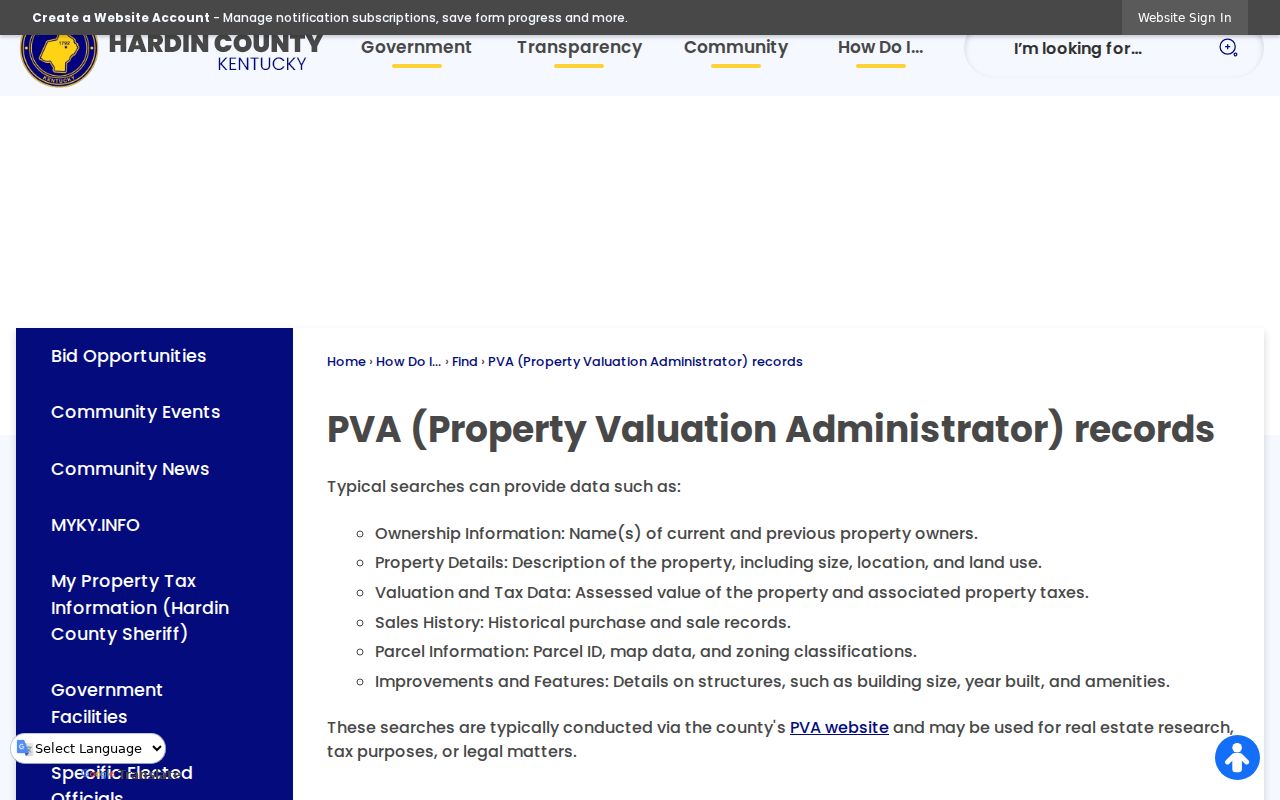
The PVA overview identifies value and sales data.
Keep the value year beside each comparison.
January First Shapes Hardin Values
January 1 sets Kentucky's listing date. The sheriff notes that tax bills name the owner as of that day. Check any sale or new construction against the assessment year. A later closing may miss the same year's billing record. The county says PVA results include assessed value, taxes, and sales history. Parcel and zoning data appear too, along with improvements. Labels on the PVA portal can vary. Read what is displayed and ask the PVA when a year is unclear.
Hardin Value Evidence Layers
Hardin County stacks value evidence in layers. The PVA gives assessment context, and the County Clerk supplies the recorded transfer. GIS checks parcel identity. The county warns its lines can skew, so a plat or survey still offers the strongest boundary evidence.
The vocabulary is small but precise. Assessed value is the official tax-administration figure. Fair cash value estimates the price in a fair voluntary sale. An assessment ratio compares assessment with market value, consideration states a value for a transfer, and a reassessment updates a later roll.
Estimate a Hardin Property Value
Start at the Hardin PVA search, and keep the parcel identity and valuation year beside every number you write down.
- Search the address or Map ID.
- Read the assessment and year.
- Note land use, improvements, and sales history.
- Open the recorded deed for consideration.
- Compare dates and legal descriptions.
- Assessed value
- The official value used in tax administration.
- Market or fair cash value
- An estimate of value in a fair voluntary sale.
- Level of assessment
- The ratio between assessed and market value.
Limits of Hardin Property Value
A Hardin County property value has limits worth knowing. The PVA figure cannot see every private condition. Contract terms, partial interests, and changes after the valuation date all escape it. Recorded consideration may reflect a gift, a family transfer, or assumed debt rather than a normal sale. For billing and contest procedures, turn to Hardin property tax records.
Kentucky's present standard is fair cash value at a 100 percent level. That still does not make every assessment a sale prediction. The PVA revalues real property each year. It adds new construction annually. It also physically examines each parcel at least once in a four-year cycle. So the effective date matters. So do the roll year, land use, and improvement data. Compare like years and similar property interests before treating two assessed values as comparable.
Old Hardin tax books need a different frame. Local library planning material notes an old Kentucky standard. Much Kentucky property was assessed at about 30 percent of fair cash value before 1965. Never set an old tax-book figure beside a current PVA number. The two levels are different. Instead, record the year, the assessment regime, the property description, and the owner name. Then use the older figure as evidence of that roll rather than a modern estimate.
Sale consideration flows from a separate record stream. KRS 142.050 uses full actual consideration for transfer-tax purposes. That includes certain assumed liens. Or it uses an estimated open-market value for a gift or no-consideration transfer. KRS 382.135 requires specified consideration and tax-bill information on many deeds. Read the deed certificate closely. A family conveyance, gift, partial interest, or debt assumption can produce a misleading number. That number may never describe an open-market sale.
Finally, match the parcel. A changed address, annexation, lot split, amended plat, or Map ID suffix can make an apparent comparison false. The PVA gives the assessment account. The deed supplies the transfer and legal description. GIS helps locate the shape. None of these is a licensed appraisal. When a value will guide a major transaction, verify the public facts first. Then obtain qualified valuation advice suited to that purpose.
Value is not price. A Hardin assessed value is not a promise of what a property would sell for and is not a licensed appraisal.