
Trace Back Hardin Former Owners
Deeds, not a single address list, hold the record of who owned Hardin County land before you. Begin with the current deed. Read the grantor's name. That same person or company appears as grantee in an older instrument. It conveys the identical land. Repeat the step over and over. Always match the legal description, Map ID, acreage, lot, and plat reference so the trail stays on one tract.
| Source | Years It Covers | Where Held | What It Shows |
|---|---|---|---|
| Clerk deed index | May 1, 1938 forward | Cott search | Grantors, grantees, dates, images |
| Books A-Z and 1-99 | 1793-1938 | Clerk archive | Earlier conveyances and indexes |
| Historic plats | From 1793 on coverage table | Clerk archive | Lots, sheets, subdivisions |
| KDLA land inventory | Ranges back to 1793 | State archives | Deeds, tax, warrants, surveys |
Start with the live Good Thru table for any modern chain of title. Its ending date shifts, so it marks the frontier of current deed records access. For deeds recorded before May 1938, turn instead to the archive indexes and deed books. KDLA and selected FamilySearch collections work well as fallbacks. They help when a county volume or probate link is easier to pin down by book and page.
Hardin's 1938 Online Divide
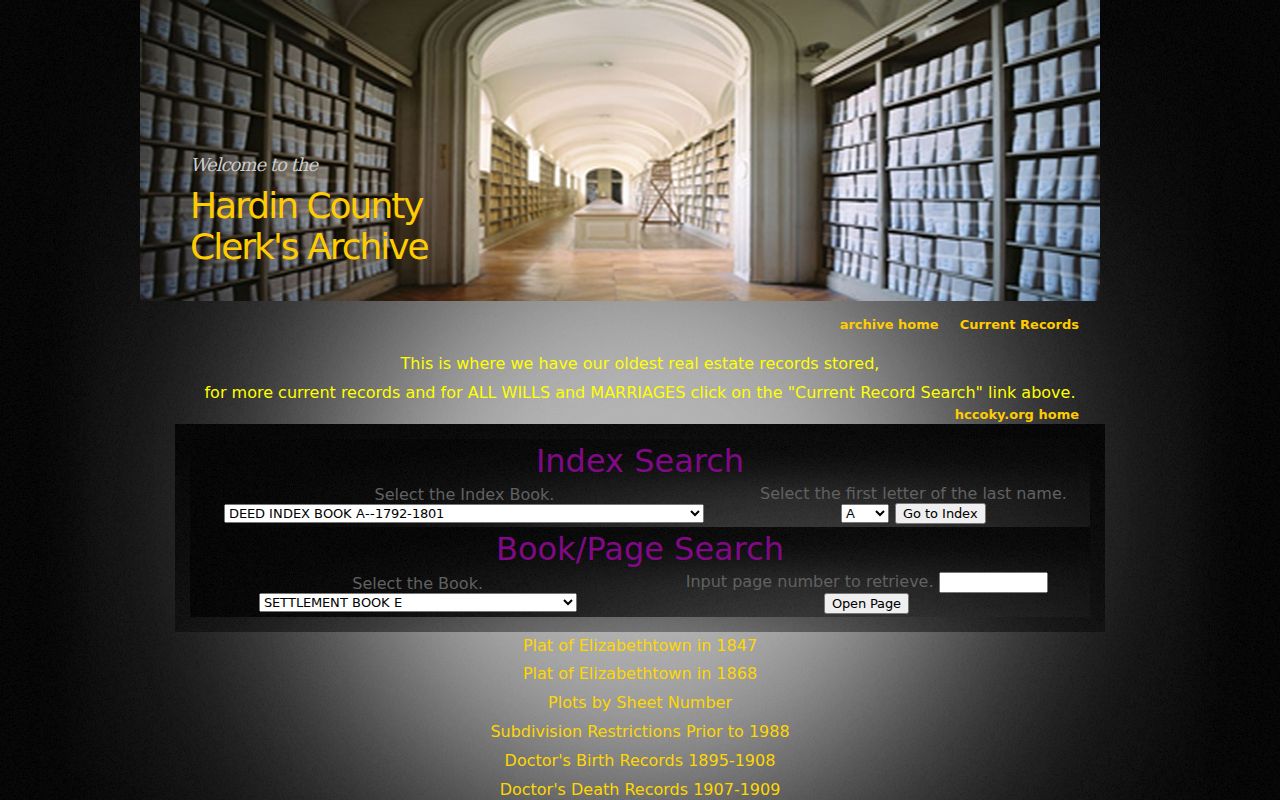
Deeds in Hardin County split at a clean line. The live Clerk coverage table starts coverage on May 1, 1938. An older system description once quoted a later cutoff. But that is migration history rather than current fact. Treat the live table as the authority on today's access. Anything recorded from 1793 through 1938 lives in archive books. Those are books A through Z and 1 through 99. Two search paths open that archive. An alphabetical Index Book search tracks parties by name. A Book/Page search goes straight to a known citation. The large historic files may need to be saved locally before they will open. No official source documents a Hardin courthouse fire or any destroyed series. So test apparent gaps against the clerk and KDLA inventories instead of crediting an unsupported fire story.
Special Books Break Simple Chains
Not every transfer left a mark in the ordinary deed books. A former-owner trail in Hardin County can pass through records that sit outside them. The clerk guide names several of these special series. They include Partitioner's Commissioner book PART1, Commissioner books under COMM1, Nolin and KU easement books, and Oil and Gas Lease Book 20 under OGL20. Probate adds another layer. A will or affidavit of descent may explain ownership between two recorded conveyances. Search the right index type and party role. Then copy the book code exactly as written. A missing ordinary deed does not end the chain. The transfer may have moved through an estate, a court-ordered sale, a commissioner, or an easement series. It may also rest in another indexed instrument entirely.
Test Each Hardin Deed Link
Street names and postal cities change over the decades. Legal descriptions hold up far better. When testing each deed link in a Hardin County chain, compare subdivision and lot, metes-and-bounds calls, adjoining owners, road or creek references, acreage, and plat sheet. GIS helps with orientation, but the county itself warns that parcel lines can be skewed by coordinate-system differences.
A grantor hands off an interest in the land. The grantee takes it. Following those pairs in order builds a chain of title, and a reverse index lets you walk that chain from the receiving side. A warranty deed promises covenants along the way; a quitclaim usually passes only whatever interest the grantor might actually hold.
The Clerk archive opens older index routes.
That split matters before the modern range.
Archive Routes for Prior Owners
For deep history, start with the Hardin Clerk archive. It keeps the county's oldest real-estate route. It also posts historic Elizabethtown plats from 1847 and 1868. KDLA catalogs deeds, tax assessments, wills, warrants, entries, surveys, grants, and plats. FamilySearch offers selected court-order and probate images. One caution applies everywhere: an index entry is never a stand-in for the original instrument. Wherever you pull a record, write down the collection, volume, page, image type, and access date. That keeps the former-owner timeline auditable. It also ensures a same-name owner of some other tract never slips into your chain.
Name Variants in Hardin Deeds
The clerk search accepts Last/Firm, First, Middle, Title, party, dates, and index type. Be flexible with names. Try initials, spelling variants, estate language, assumed names, and firm suffixes. Subdivision name works for restriction searches. A Map ID helps too. Copy any punctuation and letter suffixes exactly as the county examples show them.
Street address is not an index field here. Identify the parcel and owner through the PVA first, then work backward party by party. For pulling a single instrument, the Hardin deed records page covers that access. Former-owner research keeps its eye on the longer sequence over time.
Reconstruct Hardin's Deed Chain
Start from the parcel you have matched to today and its newest recorded conveyance, then read backward one transaction at a time.
- Find the current owner's deed as grantee.
- Read the prior owner as grantor.
- Search that grantor as an earlier grantee.
- Match the parcel description and repeat.
- At the 1938 cutoff, continue in archive books.
- Book/page
- The volume and page locator.
- Instrument image
- The recorded document, not merely its index row.
- Legal description
- The land wording used to verify continuity.
How Far Back Hardin Owners Go
Hardin County was organized in 1792 and formally established a year later. Several clerk series carry that same 1793 start date. Nothing like a single street-address portal exists. Instead, the records live in layers. Clerk books, state archives, and digitized collections each hold a piece. KDLA can push a search back into land warrants, entries, surveys, and grants.
For deeds recorded earlier than May 1, 1938, the clerk's archive is the first bridge. The Quick Start material maps the old deed books, A through Z and 1 through 99. It also maps the separate index volumes. Look up the former owner's surname first. Note the book and page cited. Then open that volume to read the deed itself. The archive also holds special commissioner, easement, and oil or gas books. A chain built only on the ordinary deed series can miss a transfer. It can also miss a property right recorded elsewhere.
KDLA's county inventory puts Hardin deeds on microfilm from 1793 through several later ranges. Originals run from 1794 through 1899. The same inventory lists land entries, warrants, surveys, grants, wills, tax books, and plats. Each group answers a different question. A tax-list name proves assessment only. It cannot stand in for the deed grantee. A will states testamentary intent. A later fiduciary or commissioner deed may show the conveyance actually recorded.
Early descriptions rarely give a street number. They name a creek, a road, an adjoining landowner, a survey call, or an acreage figure instead. Preserve every call. Then compare those calls with later plats, partition deeds, boundary surveys, and the modern Map ID. The 1847 and 1868 Elizabethtown plats help with the old city grid. Rural chains may still need metes-and-bounds work. There is no record of a Hardin courthouse fire or destroyed series. Treat a missing year as a question for the clerk or an archivist. Do not treat it as a loss.
Use the chain with care. Prior-owner records support house history, estate work, and property diligence. They are not a title opinion and must never be used to track or harass a living person.